
Polyaspartic Floor Coating: The Ultimate Guide for Oregon Homes and Businesses
Polyaspartic floor coating is a fast-curing resin system we put down on garage, shop, and commercial floors around Newberg, Tigard, and Lake Oswego. It matters here because it cures in the cool, damp conditions that slow epoxy down, and it holds its color where the sun comes through an open garage door. This guide covers what it is, how it compares to epoxy, what the install looks like, and what drives cost. If you want to see colors first, browse our floor color samples.
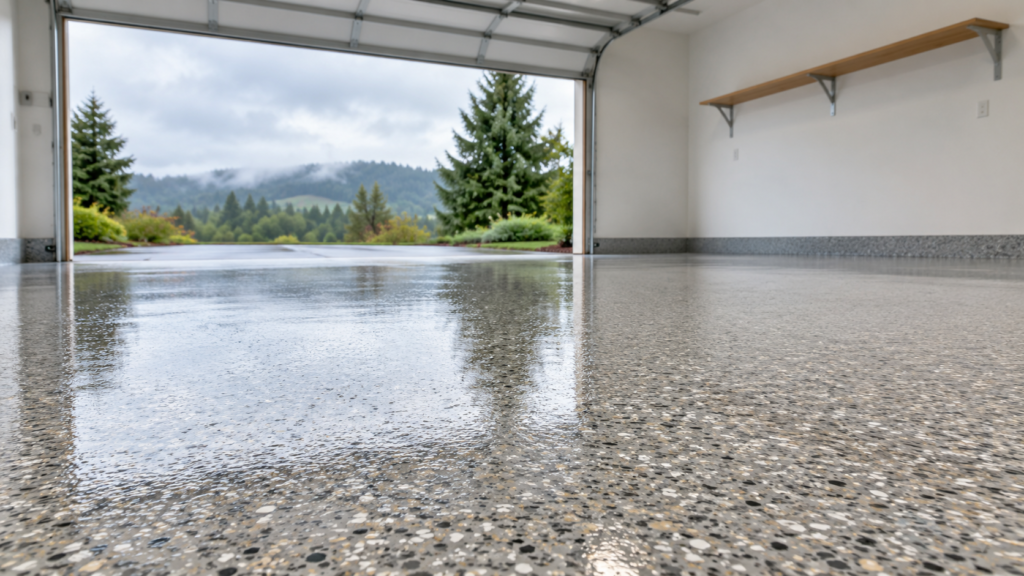
What Is Polyaspartic Floor Coating?
Polyaspartic floor coating is a type of aliphatic polyurea, a two-part resin that hardens by chemical reaction instead of drying like paint. Once the two parts are mixed, the crew has minutes, not hours, to get it on the floor, which is a big reason it’s a professional install and not a weekend kit.
On most of our floors it goes down as a full system: a base coat, a broadcast of color flake, and a clear polyaspartic topcoat.
Polyaspartic vs Epoxy: What Is the Difference?
Both are tough two-part coatings, and we install both. (Our Ultimate Guide to Epoxy Flooring in Oregon covers the epoxy side.) The differences that matter most:
- Cure time: Polyaspartic takes foot traffic in hours and vehicles in about a day on most systems. Epoxy usually needs several days before you park on it.
- Sunlight: Polyaspartic is UV stable, so it keeps its color near an open door or window. Epoxy ambers, meaning it turns yellowish over time where the sun hits it.
- Temperature: Polyaspartic keeps curing in cooler conditions where epoxy slows way down, which matters in an Oregon garage in November.
- Working time: Epoxy gives the crew more time to spread it out. Polyaspartic doesn’t, so it takes a crew that has done it many times.
How Fast Does a Polyaspartic Floor Cure?
On most polyaspartic floor coating systems you can walk on the floor in about 4 to 6 hours and park on it in about 24 hours. The exact numbers depend on the product, the temperature, and the humidity that day.
That speed is why we can finish many garages in a single day. We’ll give you the return-to-service times for your product before we start, so you can plan where the cars sleep that night.
Can You Install Polyaspartic in Oregon Weather?
Yes, within reason, and this is one of the main reasons we recommend it here. The rule we follow is that the slab has to be at least 5°F above the dew point, because when it isn’t, moisture condenses on the concrete and the coating can’t bond to it.
On a cold, wet Willamette Valley morning that can mean we bring in heat and wait instead of coating on schedule and watching it fail later.
How Is a Polyaspartic Floor Coating Installed?
- Moisture testing: Concrete holds water, and too much of it can push a coating off from underneath. We check the slab before we commit, and ASTM F2170 is the standard test method for measuring relative humidity inside a slab.
- Diamond grinding: We grind the surface to open up the concrete so the coating has something to grab. Acid etching doesn’t give the same even profile, and that’s where a lot of DIY floors start to fail.
- Crack and pit repair: Cracks, chips, and spalled spots get filled and ground flush so they don’t show through the finish.
- Base coat and flake: The base coat goes on, then we broadcast flake by hand until no base coat shows.
- Scrape and topcoat: Once the base cures, we scrape off loose flake, vacuum, and roll on the clear topcoat. A non-slip additive can go in this coat.
Where Does Polyaspartic Flooring Work Best?
Garages and shops are the most common, but it works anywhere a floor takes a beating and can’t be shut down for a week. We’ve put it down in a pet clinic, a manufacturing shop, and a commercial kitchen, where every day closed costs the owner money.
Basements and laundry rooms work too, as long as the slab passes the moisture check.
What Polyaspartic Floor Coating Can’t Do
- It won’t fix a moving crack: If the slab is still shifting, the crack can come back through the coating.
- It isn’t chip-proof: Drop a floor jack or a heavy tool hard enough and you can chip it, and dragging steel across it can scratch the topcoat.
- It won’t hide everything: Flake hides a lot, but there is nearly a 100% likelihood you’ll see some imperfections in the floor and the coating itself if you get down and look.
- Clear topcoat can be slick when wet: If the floor sees rain off cars or water in a kitchen, ask us about non-slip.
Tips From Our Floor Crew
- Clear the garage the day before: Everything off the floor, including the stuff along the walls, so the grinder can reach the edges.
- Watch the afternoon sun: When a slab warms up fast, air in the concrete can rise into the wet coating and leave pinholes. We time coats around it.
- Keep critters out: Wet coating catches anything that lands in it, bugs, leaves, and once a mouse that crawled across a fresh floor and got stuck (yes, this has happened). Keep pets and kids out and the door closed until we say it’s ready.
- Pick flake in your own light: A sample looks different under garage fluorescents than in a showroom, so hold it on your floor before you decide.
How Much Does Polyaspartic Floor Coating Cost?
A polyaspartic floor costs more than a big-box epoxy kit because most of the price is prep and labor, not material. As a rough guide for a full flake system:
- 1-car garage (about 250 sq ft): [$X to $X]
- 2-car garage (about 400 to 500 sq ft): [$X to $X]
- 3-car garage (about 600 to 750 sq ft): [$X to $X]
What moves the number:
- Old coatings: Grinding off a failed DIY coating adds time. Our garage floor epoxy paint repair shows what that looks like.
- Concrete condition: More cracks and spalling means more repair.
- Moisture: A wet slab may need a moisture-blocking primer first.
- Options: Flake blend and non-slip additive.
Polyaspartic Floors We’ve Installed
- Polyaspartic Flooring in Portland, OR: a residential install that shows the full grind, flake, and topcoat system.
- Polyaspartic Flooring for Commercial Kitchens at Sandwich Express McMinnville: a working kitchen back in service in 36 hours.
Locations We Serve
We install polyaspartic floor coating across the Willamette Valley, including Newberg, Dundee, Tigard, Lake Oswego, and Salem. We’re based in McMinnville, owned by Parker Smith, and licensed under CCB License No. 169003.
Frequently Asked Questions
Is polyaspartic floor coating better than epoxy?
For most garages in Oregon, yes, because it cures faster, handles cooler temperatures, and won’t yellow in sunlight. Epoxy still makes sense where a longer working time helps, like large commercial pours.
How soon can I park on a new polyaspartic floor?
On most systems, about 24 hours after the topcoat goes on. We’ll confirm the exact time for your product before we start.
Can polyaspartic go over an old epoxy floor?
Not as-is. We grind off loose or failing coating first, because a new coating is only as strong as what’s under it.
Is a polyaspartic floor slippery?
The flake adds some texture, but a clear topcoat can be slick when wet. A non-slip additive in the topcoat fixes that.
Can polyaspartic floors be installed in winter?
Yes, within reason. The slab has to stay at least 5°F above the dew point, so on cold, wet days we may add heat or reschedule.
About Smith & Company Painting
Smith & Company Painting is a family-run residential, commercial, and industrial painting contractor based in McMinnville, OR, serving Yamhill County and the Willamette Valley. We are licensed under CCB License No. 169003 and handle everything from exterior repaints to floor coatings.
Contact Smith & Company Painting for expert residential exterior painting in Dayton, OR and throughout Northwest Oregon.
Why Choose Smith & Company
Visit us: 570 SE Davis St, McMinnville, OR 97128
Call us: 503-472-4334
Learn more: smithandcompanypainting.com
Smith & Company Social Media Pages
Facebook Instagram Tiktok YouTube LinkedIn X
