
Painting stairs and railings takes more patience than any other interior job, because every surface gets touched, stepped on, or brushed past every day. In Newberg, Portland, and Lake Oswego, we see a lot of older oak banisters and builder-grade stairwells that people want to brighten up, and the paint only holds if the prep and product are right for that kind of wear. This guide covers what to use on each part of the staircase, how to prep a stained rail, and how to paint the stairs while you still need to use them. If you’d rather have us handle it, see our House Painting Services.
Why Is Painting Stairs and Railings Harder Than Painting a Room?
Painting stairs and railings is harder because the surfaces are constantly in contact, and there are dozens of small, round, or angled pieces to cover evenly. A wall gets bumped now and then. A handrail gets grabbed by oily hands dozens of times a day, and treads get walked on with shoes, socks, and pet claws.
That wear causes three common problems:
- Peeling on the rail: paint over a glossy, varnished handrail without sanding and priming has nothing to grip, so it peels where hands rub it most.
- Sticky surfaces: latex semi-gloss can stay slightly tacky for days, so a rail or tread put back into use too early picks up fingerprints and sock fuzz.
- Worn treads: regular wall or trim paint on stair treads wears through to bare wood in the walking path, usually within a year.
What Is the Best Paint for Stairs and Railings?
The best paint for stairs and railings is a hard-drying interior enamel in semi-gloss, with a floor-rated paint or a clear finish on the treads. Each part of the staircase takes a different kind of wear, so we don’t use one product on all of it.
- Handrails and spindles: a semi-gloss waterborne enamel that dries hard and wipes clean.
- Risers and skirt boards: the same semi-gloss enamel, since these take scuffs from shoes and vacuums.
- Stairwell walls: eggshell or satin, which holds up to hands and shoulders without showing every drywall flaw.
- Treads: a porch and floor paint, or stain with a clear floor finish if you’d rather keep the wood look.
Sherwin Williams and Rodda both carry interior enamels built for high-traffic trim. Ask for an enamel by name instead of a general wall paint in semi-gloss.
Can You Paint Stair Treads?
Yes, you can paint stair treads, but they need a floor-rated paint and a little grit. Painted treads in a smooth finish are slippery in socks, so we mix an anti-slip additive into the final coat on any tread that will be painted.
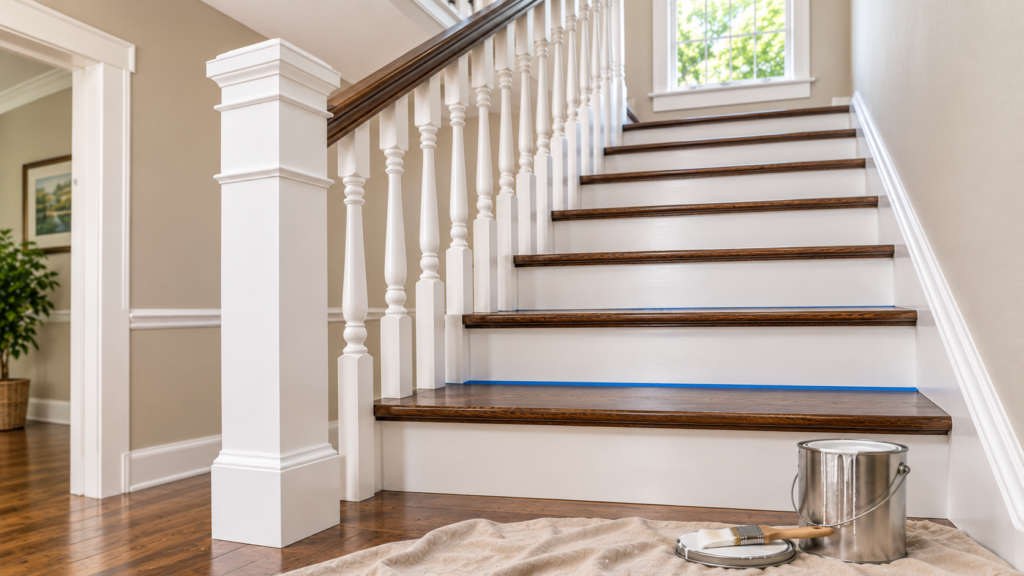
If your treads are solid hardwood in good shape, staining and clear-coating them often looks better and wears longer than paint. A common look is painted risers and spindles with stained treads and a stained handrail.
How to Prep a Stained Banister for Painting
A stained and varnished banister has to be cleaned, sanded, and primed, or the paint will peel. Most handrails in older Oregon homes have a glossy clear finish over oak, and that finish is the reason paint fails on them.
- Degrease the rail: years of hand oils build up on a handrail. Wash it with a degreasing cleaner and rinse, or the primer won’t stick.
- Scuff sand everything glossy: sand the rail, spindles, and newel posts with fine sandpaper until the shine is gone. You’re not removing the finish, just dulling it.
- Fill dents and nail holes: stairs collect dings. Fill them with wood filler and sand smooth.
- Caulk the gaps: run paintable caulk where the skirt boards meet the wall and where risers meet treads, so the lines look clean.
- Prime with a bonding or stain-blocking primer: oak tannins can bleed through as yellow or brown spots, and a stain-blocking primer stops that. Our Priming 101 guide covers which primer goes where.
Oak also has open grain that shows through paint. If you want a perfectly smooth rail, ask about grain filling before priming. Most people are happy with the texture once it’s painted.
How to Paint Stairs and Railings, Step by Step
- Work top to bottom: paint the stairwell ceiling and walls first, then the handrail, spindles, skirt boards, risers, and treads last, so drips only land on things you haven’t painted yet.
- Paint spindles one at a time: brush from the top of each spindle down, and check the back side before moving on. Spindles are where most drips and missed spots hide.
- Brush the handrail in long strokes: follow the length of the rail and keep a wet edge so the brush marks level out.
- Apply two thin coats: two thin coats dry harder and smoother than one heavy coat, which is what causes drips and stays soft.
- Do the treads last: roll or brush the treads, adding the anti-slip additive to the final coat.
On a staircase with a lot of spindles, we often spray instead of brushing, with everything else masked off. It’s faster and leaves a smoother finish, but the masking takes most of a day.
How to Paint Stairs and Still Use Them
To paint stairs you still need to use, paint every other tread, let them dry overnight, then paint the rest the next day. You can step on the bare treads in between.
- Mark the bare treads: a strip of painter’s tape on the ones that are safe to step on keeps everyone from guessing.
- Use the rail on one side only: if the rail runs on both sides, paint one side at a time so there’s always something to hold.
- Plan for pets: keep pets off the stairs or behind a gate until the treads are dry, or you’ll find paw prints all the way down (yes, this has happened).
How Long Before You Can Use Painted Stairs?
Wait at least 24 hours before walking on painted treads or using a painted handrail, and longer in a cool house. Most interior enamels feel dry in a few hours but take 2 to 4 weeks to fully harden, so go easy on the stairs for the first few weeks.
- Keep shoes off painted treads for the first week if you can.
- Don’t put a runner or rug back on painted treads until the paint has cured.
- If the handrail feels slightly sticky after a day or two, give it more time before heavy use.
When Should You Hire a Pro for a Stairwell?
Hire a pro when the stairwell wall is too tall to reach safely from the stairs. Two-story stairwells in newer homes can run 16 feet or more, and painting them safely takes a stair ladder, planks, or scaffolding set up on uneven steps.
A tall stairwell is not the place to lean an extension ladder against a wall. We bring the setup for it, and it’s usually what people call us for even when they plan to paint the rest of the house themselves.
See Our Stairway Painting Projects
For real examples, browse our interior painting projects, including the stairway job in Newberg and the condo stairwells at Marshall Wells Lofts in Portland. For apartment and condo buildings, see our Hotels and Apartments page.
Locations We Serve
Smith & Company Painting paints stairs, railings, and stairwells in Newberg, OR, Portland, OR, Lake Oswego, OR, Beaverton, OR, and Milwaukie, OR. We’re led by Parker Smith and fully licensed (CCB License No. 169003).
Frequently Asked Questions About Painting Stairs and Railings
What is the best paint for a stair railing?
A hard-drying interior enamel in semi-gloss. It holds up to hands and wipes clean better than standard wall paint.
Do you have to sand a stained banister before painting?
Yes. Scuff sand until the shine is gone, then prime with a bonding or stain-blocking primer, or the paint will peel.
Can you paint stair treads?
Yes, with a porch and floor paint and an anti-slip additive in the final coat. Smooth painted treads are slippery in socks.
How do you paint stairs and still use them?
Paint every other tread, let them dry overnight, and paint the rest the next day. Mark the bare treads with tape so everyone knows where to step.
How long does painting stairs and railings take?
Most staircases take us 2 to 3 days, including prep, priming, and two coats. Stained rails and a lot of spindles add time.
About Smith & Company Painting
Smith & Company Painting is a family-run residential, commercial, and industrial painting contractor based in McMinnville, OR, serving Yamhill County and the Willamette Valley. We are licensed under CCB License No. 169003 and handle everything from exterior repaints to floor coatings.
Contact Smith & Company Painting for expert residential exterior painting in Dayton, OR and throughout Northwest Oregon.
Smith & Company Social Media Pages
Facebook Instagram Tiktok YouTube LinkedIn X
